Experimental poetry followed many directions in several countries
in the twentieth century. Each new direction attempted to address the
historical, cultural, and often political needs of its own time. Between
1978 and 1982 I worked with countless experimental poetic styles, trying to
develop my own direction. I explored traditional versification,
recitation, body-based performance, visual poetry, graffiti, collage,
typography, color, object-poems, sound, and a number of other
possibilities. As a result of this relentless experimentation, I felt on
the one hand that the printed page imprisoned the word within its
two-dimensional surface, thus creating specific limits to poetic
expression. On the other hand, I realized that the construction of solid
three-dimensional objects gave the word a permanence and a physical
presence that contradicted the dynamics of language. I was looking for a
poetic language that would be malleable, fluid, and elastic. It was clear
that I had to work with a new medium, beyond the page and the object–a
new medium that would still allow for the private experience of reading a
poem. My conclusion was that the solution might lie somewhere between the
two-dimensional surface and the three-dimensional volume–in thin air. I
envisioned in my mind's eye a poetic form that would exist beyond the page
without being embodied on tangible objects. A poetic form that would be
flexible, buoyant, and oscillatory as the thought process itself, and that
could give new communicative power to the word. As I projected with great
enthusiasm in my mind's eye what such a poetry would be like, I also
thought that this dream was unachievable since it founded the principles of
this new syntax in new media that–at least for me, at the moment–did
not exist yet. My goals seemed, at first, anything but within reach.
Holography was in my mind. I had read about it, but could not
quite visualize what a hologram was like–until I saw one. The
experience of seeing a hologram for the first time early in 1983 was
intense. I immediately recognized in this new medium the immaterial and
kinetic solution to the poetic problem I had developed. I spent the next
couple of years making the first holopoems and developing the theory of
holopoetry. This work resulted in the first international exhibition of
holopoems, in 1985, at the Museum of Image and Sound, in São Paulo. From
the start the breaking down of the immaterial space of holography, as well
as the development of non-linear temporal systems, have been the basis of
my holographic syntax.
My objective has always been not to use holography for its obvious
three-dimensional qualities. I asked myself: what would be the difference
between a sculpture of letters and a hologram of this sculpture? The
difference was not significant. I immediately realized that holography was
much more complex than the touted "illusion of three-dimensional space."
This new medium has an incredible power not only to create an immaterial
visual poetic experience, but to manipulate temporal systems, and to store
information in ways that can be carefully controlled to generate
fascinating new perceptual experiences. That is what I was after, and that
is what I have been exploring since then.
I must make it clear that I do not consider holographic poems those
holograms that record or reproduce verbal material already successfully
realized in other form or media. It is important to explore the unique
qualities of the holographic medium itself and to develop a truly genuine
"holographic writing."
In order to clarify some of the unique aspects of my holopoetry,
and also to help delineate some of the new compositional elements I have
developed since 1983, I will discuss in what follows some of the key
concepts of holopoetry. This will also work as a glossary of sorts, which
can be used as a reference in the reading of my other texts as well as in
the discussion of the holopoems themselves.
ANIMATION
Animation in holopoetry refers to the fact that the words employed in a
piece are set in motion. This is usually produced on a computer and then
transferred to the hologram, although purely holographic animations are
also used occasionally. Computer animations are created specially for the
syntax of the holopoem. This involves a complex pre-visualization
experience. Computer animations that are created for video or film do not
work well in a hologram. This is due to the differences between the
monoscopic surface of screen-based animations and the stereoscopic space of
the hologram. A holographic animation must be created taking into account
the stereoscopic perception of the viewer.
BEHAVIOR
In visual poems created for print, letters and words can be said to have a
specific position on the page. These letters and words are arranged into a
unified visual composition. In holopoetry, letters and words cannot be
said to have a specific position or composition. Instead, they exhibit a
particular kind of behavior. Something happens to letters and words as
they are read by the viewer. Active behavior replaces static structure.
BINOCULAR READING
I call binocular reading the process according to which some holopoems
present different letters and words to each eye simultaneously. This
feature is unique to holopoetry, and transforms the reading process. Normally, when looking at objects around us, we
perceive two different points of view of the very same object. Binocular
reading takes place when we read one word or letter with the left eye and
at the same time a completely different word or letter with the right eye.
Many holopoems–"Amalgam," for example–rely on this principle for their
syntactic and semantic efficiency.
COLOR
In holopoetry color is not fixed. It is relative. One viewer can see a
letter in one color and immediately see it change into another. Two
readers looking at the same word could see it in different colors
simultaneously. While many holographers are disturbed by this
uncontrollable behavior, I find it perfectly appropriate to stress the
ungraspable nature of meaning. The oscillatory nature of color in my
holopoems moves away from traditional symbolism and from the use of color
as a structuring visual element. The chromatic system of each holopoem is
created within certain parameters, which I specify. The creation of
viewing zones and the behavior of color in a holopoem are intrinsically
related, since form and relative position of viewing zones affect the
diffraction of light.
DIGITAL HOLOPOEMS
Computer holopoems, or digital holopoems, are holopoems created from
digital data, instead of physical letters made of metal, wood, and other
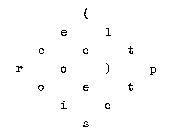
materials. My first digital holopoem, "(Quando?, When?)," was created between
1987 and 1988. Since 1989, all of my holopoems have been created with
computers. If a holopoem is not made with the aid of a computer, I call it an "optical holopoem."
DISCONTINUOUS SPACE
Discontinuous space is created in a holopoem when the homogeneity of the
three-dimensional volumetric space of the hologram is broken down into
discrete spaces that may or may not overlap in space, or time.
DISCONTINUOUS SYNTAX
The holopoem organized in a discontinuous space takes advantage of the
logic and topology of this new poetic space. It presents the verbal
material with a syntax of actual, perceptually real leaps and oscillations.
EMPTY SPACE
Quite literally, in holopoetry "empty space" refers to the fact that the
poem is read in an immaterial and empty space, visually located between the
recording medium (holographic film) and the viewer–and not on the
surface of the page. This implies that holopoetry does not operate within
the logic of traditional visual poetry inherited from Mallarmé, according
to which the white on the page represents silence and the black type
represents sound. Holopoetry undermines the subjugation of written
language to phonetic systems and affirms the verbal experience based on the
possible appearance or disappearance of graphemes within empty spaces. The
white on the page which represented silence is removed and what remains is
empty space, an absence of (printing) support which has no primary symbolic
value. The vacuous gaps between words and letters do not represent
positively absence of sound, because the photonic inscriptions don't stand
essentially for its presence. We are in the domain of spatiotemporal
writing, four-dimensional writing, if we wish, where spatial gaps don't
point to anything except for the potential presence of graphemes. The
voids are not to be "seen," unlike the white on the page. They are a quite
literal interplay of absence and presence.
FLUID SIGN
A fluid sign is essentially a verbal sign that changes its overall visual
configuration in time, therefore escaping the constancy of meaning a
printed sign would have. Fluid signs are time-reversible, which means that
the transformations can flow from pole to pole as the beholder wishes, and
they can also become smaller compositional units in much larger texts,
where each fluid sign will be connected to other fluid signs through
discontinuous syntaxes. Fluid signs can also operate metamorphoses
between a word and an abstract shape, or between a word and a scene or
object. When this happens, both poles reciprocally alter each others'
meanings. A transfiguration takes place and it produces in-between meanings
that are dynamic and as important in holopoetry as the meanings produced
momentarily at the poles. Fluid signs create a new kind of verbal unit, in
which a sign is not either one thing or another thing. A fluid sign is
perceptually relative. For two or more viewers reading together from
distinct perspectives it can be different things at one time; for a
non-stationary reader it can reverse itself and change uninterruptedly
between as many poles as featured in the text. The holopoem "Souvenir
D'Andromeda" is an example of this.
HOLOPOEM
A holographic poem, or holopoem, is a poem conceived, made, and displayed
holographically. This means, first of all, that such a poem is organized
in an immaterial three-dimensional space, with complex non-linear temporal
characteristics, and that even as the reader or viewer observes it, it
changes and gives rise to new meanings. Thus as the viewer reads the poem
he or she constantly modifies the text. As distinguished from traditional
visual poetry, it seeks to express dynamically the discontinuity of
thought; in other words, the perception of a holopoem takes place neither
linearly nor simultaneously but rather through fragments seen at random by
the observer, depending on the observer's position relative to the poem.
Perception in space of colors, volumes, degrees of transparency, changes in
form, relative positions of letters and words, animation, and the
appearance and disappearance of forms is inseparable from the syntactic and
semantic perception of the text.
HOLOPOETRY
Holopoetry is the word I coined in 1983 to name the new poetics I then
introduced. By virtue of necessity, holopoetry can only be fully
experienced via the creation of experimental works with the medium of
holography. Today holopoems are stored on film. In the future, however,
digital holopoems will be stored optically on discs. The exact storage
media will change. That is not what defines a holopoem. Holopoetry is
defined by unstable spaces, immateriality, four-dimensionality,
interactivity, movement, relative perception, and related concepts.
HYPERPOEM
A hyperpoem is a digital interactive poem based on a system (hypertext)
that branches out as the reader makes choices along the way. Hyperpoems
promote a disengagement of the textual distribution characteristic of
print. The node–and not the syllable–from which links irradiate is
the new unit of measurement. The writer now defines the work as
crisscrossing axes of combination. The reader has to make selections in a
way that is similar, albeit not identical, to the way the writer has. The
reader is now presented not with one narrowed-down selection of words in
strings or in graphic layouts, but with an electronic field that is a
complex network with no final form. In each node the poet will deploy text
or add sound and moving images to it. In the future, when holography
becomes digital, holographic hyperpoems will become possible.
IMMATERIALITY
In holopoetry, immateriality refers to the fact that the verbal material is
organized in a space made of diffracted light, and not on any tangible or
concrete form, such as the printed page. This new space, defined by
photons, has no mass or tangible expression.
INTERACTIVITY
A holopoem is interactive in the sense that the natural movement of the
viewer in front of the holopoem is enough to change what he or she reads.
Every new movement reveals new reading possibilities, including the
appearance or disappearance of verbal forms. In the future, when digital
holograms become scriptable, it will even be possible to modify or add to
the elements in the holographic text.
NON-LINEARITY
Holopoems are not organized with a beginning, middle, and end, as a poem in
verse commonly is. Neither are holopoems printed on a page, with its
suggested reading from left to right and top to bottom, or its opposite,
the simultaneous ideogram. Discontinuous holopoems are read in leaps.
Sequential holopoems are based on the principle of temporal reversal.
PARALLAX
An apparent change in the direction of an object, caused by a change in
observational position that provides a new line of sight. Many holopoems
explore parallax semantically. For example: in "Omen," the word "eyes" spins
inside a cloud of smoke. As the viewer moves from left to right and vice
versa, the word appears and disappears, suggesting multiple readings.
PERCEPTUAL SYNTAX
If visual poetry developed a visual syntax–based on the rejection of
traditional syntax and on the elaborate visual treatment of the words on
the page, holopoetry develops a perceptual syntax–based on the rejection
of the static syntax of print and on the development of complex and dynamic
spaciotemporal verbal systems. A holopoem calls for non-linear perceptual
responses to the words, which are experienced in time–and not for the
simultaneity of gestalts.
PSEUDOSCOPY
The opposite of "orthoscopy," or the correct optical representation of a
holographic image. Under certain conditions, a hologram can be made to
reverse its image in space and time. A concave object is perceived as a
convex pseudoscopic image. An object that rotates to the right is seen
rotating to the left. Objects that appear in front of other objects are
seen behind these objects in the pseudoscopic image. Objects that are seen
behind the holographic plate float freely in pseudoscopic space in front of
the plate. This feature is unique to holography and has been explored in
holopoetry since the beginning. The first holopoem, "Holo/Olho," from 1983,
is based on this principle, and so is "Chaos," and "Wordsl 2."
SEMANTIC INTERPOLATION
In certain works, as the viewer moves relative to the holopoem, he or she
perceives that each graphic line that renders the visual configuration of
each letter starts to actually move in three-dimensional space. The viewer
then perceives that as the lines and points go under an actual topological
transformation, they slowly start to reconfigure a different letter. In
"Astray in Deimos," what was read as an adjective is becoming a noun, for
example. I call this semantic interpolation. If the viewer happens to
move in the opposite direction, the noun is transformed into the adjective.
The shifting of grammatical forms occurs not through syntactical
dislocations in a stanza, but through a typographic metamorphosis that
takes place outside syntax. The meanings of in-between configurations can
not be substituted by a verbal description, or by a synonym. Neither can
it be replaced by a specific word, as gray suggests a specific intermediary
position or a meaning between black and white. In holopoetry transient
clusters of letters or ephemeral shapes that lay between a word and an
image aim to dynamically stretch the poetic imagination and suggest
meanings, ideas, and feelings that are not possible to convey by traditional
means.
TEXTUAL INSTABILITY
By textual instability I mean precisely that condition according to which a
holographic text does not preserve a single visual structure in time as it
is read by the viewer, producing different and transitory verbal
configurations in response to the beholder's perceptual exploration.
TIME-REVERSIBILITY
Time-reversibility takes place in holopoems, such as "Zephyr," which are made
so as to be read from any temporal pole with equal semantic efficiency.
This means, for example, that if one starts reading an animated holopoem
from right to left (or top to bottom, or back to front), this holopoem can
also be read from left to right (or bottom to top, or front to back). The
time vector of the piece is reversible.
TRANSITIONAL DISCONTINUITY
In most holopoems, discontinuity is explored via leaps and gaps between the
verbal material. In some cases, as in "Shema (1989)," letters are embedded
in color fields that operate verbal discontinuity via visual transitions of
colors. I call this "transitional discontinuity."
VIEWING ZONE(S)
A viewing zone is a non-physical zone, located in front of the hologram,
through which the reader can actually see the words in the poem. When I
create a holopoem, it is part of my writing process to decide how wide,
tall, and deep the viewing zones will be. I also decide the shape and
relative position of these viewing zones. I can decide how many will there
be and what gaps might there be between them. I can combine multiple
viewing zones and edit them in many ways. I can decide on a number of
viewing-zone parameters, which I use to create the unique quality of each
work. The reader never sees a visual representation of these viewing
zones. They are invisible. Viewing zones can be rendered sequentially and
discontinuously, which helps create the space and the syntax of each
holopoem.
Originally published in Experimental–Visual–Concrete: Avant-Garde
Poetry Since the 1960s, Edited by K. David Jackson, Eric Vos, and Johanna
Drucker, Amsterdam–Atlanta, GA, Rodopi, 1996, pp. 247-257.
Eduardo Kac's works in electronic and photonic media belong to the permanent collections of the Museum of Modern Art in New York, the Museum of Holography in Chicago, and the Museum of Modern Art in Rio de Janeiro, Brazil; samples can be seen
at his website, http://www.uky.edu/FineArts/Art/kac/kachome.html. He is a member of the editorial board of the journal Leonardo and an assistant professor at the Art Institute of Chicago. His anthology, New Media Poetry, is reviewed in this issue of ebr.