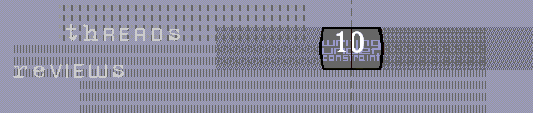
The best illustration of Johnston's concept of a media assemblage is
the book's cover art, by Gregory Rukavina, titled Mr. Memory (The 39
Steps) - a collage of (presumably) 39 gray rectangles of various sizes
arranged in several planes on which letters and numbers have been
projected as if through a camera lens. The media effects are thus
distributed over a non-continuous surface, and any illusion of depth is
created by the arrangement of the surfaces, their manner of overlapping
and the gaps between them. The letters and numbers do not spell out or
add up to anything; rather, they remain in their literal materiality,
resisting interpretation (unless one goes outside the system of
literal projection and relates the whole to the Hitchcock film alluded
to in Rukavina's title). By contrast, Strehle's cover illustration, by
Molly Renda, features three rectangles of the same size connected along
a single vertical, so that the middle rectangle suggests a page turning
in a book. The three figures are set against a speckled black
background. This underlying plane alters the coloration and geometric
details sketched on the "pages," but it remains separate and formless,
an indistinct "reality" affecting, but largely unaffected by, the pages
through which it is viewed.
More consistently than Strehle and perhaps any other U.S. critic,
Johnston has brought the range of poststructuralist theory to bear on
American fiction's most discussed experimental texts. Specifically,
Information Multiplicity takes its key terms, "assemblages,"
"multiplicity," and "machinic phylum," from Gilles Deleuze and
Felix Guattari; also important are the "discourse networks" or
"writing-down systems" (Aufschreibsysteme) from Friedrich
Kittler,

 who decisively generalizes the notion of medium,
applying it to all domains of cultural exchange in the social
environment no less than in processes of psychological individuation. Like the works by Kittler and Deleuze dealing specifically with literary
texts, Johnston's criticism is valuable not for offering new
interpretations (readers will find little here that is not
already implied in Johnston's precursors). Instead, it resituates the
critical discussion by drawing attention to the impact of media
themselves, that is, the interdiscursive networks that link writers,
archivists, addresses, and interpreters. Where Strehle adopts the word
"actualism" to designate the space between text and world
where meaning is generated, Johnston uses the term "mediality" to
indicate the ways in which a literary text inscribes in its own language
the effects produced by other, nonliterary, media. Johnston's critical
mission is to ascertain how these media effects - our culture's technological unconscious - are narrativized
or how they can be seen to condition conscious awareness as a "reading
effect."
who decisively generalizes the notion of medium,
applying it to all domains of cultural exchange in the social
environment no less than in processes of psychological individuation. Like the works by Kittler and Deleuze dealing specifically with literary
texts, Johnston's criticism is valuable not for offering new
interpretations (readers will find little here that is not
already implied in Johnston's precursors). Instead, it resituates the
critical discussion by drawing attention to the impact of media
themselves, that is, the interdiscursive networks that link writers,
archivists, addresses, and interpreters. Where Strehle adopts the word
"actualism" to designate the space between text and world
where meaning is generated, Johnston uses the term "mediality" to
indicate the ways in which a literary text inscribes in its own language
the effects produced by other, nonliterary, media. Johnston's critical
mission is to ascertain how these media effects - our culture's technological unconscious - are narrativized
or how they can be seen to condition conscious awareness as a "reading
effect."
Johnston's narrative, like Strehle's, is decidedly entropic, but it
does not lead (as does Strehle's) to a conception of the real and its
textual constructions as shapeless and random. Moreover, because it is
situated in specific technological transformations rather then in a
generalized epistemological shift, the narrative describes historical
changes among novelists and from one work to another, which get elided
on Strehle's actualistic template. Indeed, where Strehle (like many
critics trained in the sixties) finds non-hierarchical and non-linear
structures liberating, Johnston knows that such flexible structures
largely redefine power in "the military-industrial complex born from
World War II" (63). Specifically, Johnston's master narrative works in
three stages, proceeding from: 1) a time of separate and separable
media (registered in such works as Gravity's Rainbow, Lookout
Cartridge, and JR); to 2) "a condition of partially
connected media systems" in DeLillo's later novels and Pynchon's
Vineland (where differences in media, as in the transition from
filmic to digital registrations, still offer spaces of resistance to
newly aggregated structures of corporate power); to 3) the prospect, in
cyberpunk fiction, of media's "disappearance" into "a totalized, global
information economy" in which "cyborg culture becomes the only culture"
(233-34).
Wittgenstein claimed, in the 1922 preface to the Tractatus,
that he had put to rest philosophy's open problems. Yet his point was
that total connectivity in philosophical understanding would change
nothing in the world; only our perception of the relations among its
elements would change. Something similar would seem to be true of the
cultural implosion of distinct media into a single medium in which, for
the first time in history or for the end of history (as Kittler has
said), sound, visuals, and text exist on the same digital platform.
Referring to the mental state of William Gibson's protagonist at the
climax in Neuromancer, Johnston writes: "To Case's relief
and amazement, the fusion of the two AIs appears to change very little,
at least from the human perspective, since what this fusion brings about
is the AIs' transcendence of human affairs altogether" (245). The newly
homogenized technopolitical world order helps to explain the return to
stylized, but "rather conventional orderings" in much cyberpunk fiction
(Johnston 6; Andrew Ross makes a similar observation in
Strange Weather [1991]). "In certain respects," writes Johnston,
the machinic phylum "has evolved into a zone much like the street"
(246).
What changes, then, is not the known environment but our mental
creation of its elements - and its reciprocal creation, in us, of a
mixture of (not exclusively literary) "reading effects." More than an
index of cultural entropy, the external media environment becomes, at
least implicitly in Johnston, a cognitive map of a new form of
subjectivity, one that is "displaced and redistributed throughout the
entire machinic activity that writing and reading these novels entails"
(5). This new subjectivity, "a contemporary version of what Freud called
the 'psychic apparatus'" (14), emerges specifically from new ways of
textualizing memory and perception. And just as Freud's contemporaries
found it useful to redefine consciousness in relation to the emergent
medium of their time, cinema, contemporary subjectivity finds
theoretical elaboration (in Lacan's symbolic order, Deleuze's
"machinic phylum," and Kittler's "discourse networks") as "an
interiorized reflection of the current standards of all technical media"
(33). Multiplicity is essential, for it is in the gaps among media
and, more specifically, in the gaps between the reader and the media
effects registered by the novel, that such fiction models the dynamics
of a psychic apparatus (33, 51).
As the return to conventional form in cyberpunk reveals, however,
literary narrative remains hard pressed to keep up with the expansive
orderings of contemporary media. For all the newly decentered
environmental webwork, narrative, as Johnston realizes, must be
"anchored to a perspective and thus to a center of intentionality." Sophisticated prose fictional narratives, such as Gravity's
Rainbow, counter the digitalization of information "by transposing
its history into a continuous but indeterminate stream of delirious
media effects." Thus Pynchon's novel "mimics film, radio, dance
hall music, drug-induced hallucinations, and seances in which the dead
speak" (63). In JR, as in Raymond Williams's conception of
televisual "flow," the center of intentionality need only be transferred
from the level of narrative content to that of corporate organization.
Once we consider programming rather than programs, corporate agents
rather than human agencies, "interruption is transformed into something
like its opposite, continuity," and the result is a trans-personal - though, again, ultimately delirious - intentionality (125). Such
insights are unavailable to Strehle, although they have been worked out
elsewhere in Pynchon and Gaddis criticism.>3
Yet, where Strehle narrates a
universal dissolution of narrative energies, Johnston's finely tooled
machinic assemblage repeatedly threatens to go out of control. It is
unclear, given his wholly machinic view of human consciousness, whether
his framework can allow for the emergence of any mind that is not
delirious - that is, not riddled by anxiety at its own groundlessness.
Another way of looking at delirium might begin with the word's
etymology - from the Latin, de lira, meaning "out of the furrow." The
word delirium can then refer, as the novelist and art critic William S.
Wilson has pointed out, to a faulty plowing in which the plow pulls out of the
furrow. Equally, in a literary context, where rational thought proceeds
in a line furrowed with opposites, to be delirious can mean to go
outside oppositional thinking. A plow pulls out of the furrow, where
rooted plants are meant to grow in straight lines. That's one way of
transitioning from striated to smooth space, in Deleuze's vocabulary.
Outside ond over the furrow, untended vegetation is likely to be rhizomatic. And so is
narrative when it resists the linearity of sentences on a page and
tries to get outside the furrowed oppositions and rootedness of rational
thought.>4
Rhizomatic thought, like rhizomatic narrative, needs no ground
or foundation; rather, it finds support horizontally, through a process
of expanding connections, and thus creates a foundation as it goes, in
what Joseph McElroy (in a narrative vein very much in tune with Deleuze)
would term a "collaborative network" or, more simply, "Field."
In a chapter on McElroy's Lookout Cartridge, which differs from
comparable meganovels in being restricted to the first-person viewpoint
of a single narrator, Johnston again formulates Field as a "novelistic
dilemma: how can a narrative cause information to proliferate from
varied perspectives and thus sketch a collaborative network, all the
while remaining attached to the consciousness or point of view of a
single individual subject?" (98-99). A number of potential answers may be
found in the ensemble of theories and perspectives currently gathered
under the heading of "cognitive science," which Johnston references in
an early footnote to Martin Gardner's Mind's New Science and in a
more extended reference to Daniel Dennett's concept of consciousness as a
revisionary process involving "multiple drafts" (104-05). Indeed,
although Johnston doesn't say so explicitly, his narrative center and
source of continuity, which the novelist must construct among "partially
connected media systems," functions very much like the conscious mind as
currently understood - responding to gaps in awareness and
incommensurable representations by creatively linking them into a
workable mental image or patchwork representation. Although Johnston
does not make the attempt, a more direct and sustained translation
between mental and media ecologies would no doubt expand our
understanding of the particular constraints relevant to contemporary
aesthetic experience.
For opening this line of inquiry (in a chapter that succeeds at
last in bringing into focus both the nature of McElroy's so-called
"difficulty" and his unique importance), and for more generally linking
questions of literary self-consciousness to self-reflexive systems in
the larger media environment, Johnston's book deserves the widest
possible readership, among literary theorists and practical critics
alike. One must wonder, though, whether the implications of Johnston's
argument have not already changed the climate in which such a reception
has been possible. The energies unleashed by modern physics, media
theory, and cognitive science have migrated in ways that neither of
these two books anticipates. As Strehle has produced no successor in the
systematic application of models from quantum physics, neither will
Johnston. The linear explication of a fractalizing discourse needs
to be done only once. Responsibly raising the standard of contemporary
criticism of fiction, Johnston has made graduate seminars in Pynchon,
Gaddis, McElroy, and the like a possibility for perhaps another decade. But
given new curricular demands for attending to the popular culture
produced by the very corporate media whose "effects" these novelists
recreate, it is doubtful that students will have time to go on reading
these novelists as a group or even their individual works in their entirety.
Surely it is time that criticism come to terms with the fact that
contemporary media of reception have doomed their most complex and
accurate chronicles to the status of unread classics. If these
word-happy novels came into prominence at a time when critical thought
was completing a "linguistic turn," in Richard Rorty's phrase, they
enter obsolescence at a moment that might now be characterized as a
"medial turn" - a cultural transformation these books anticipate and
urge on in their thoroughgoing articulation (in writing) of non-literary
media effects. The book itself will not be unchanged by these media
transformations, and critical practice will also require appropriate
adjustments. Instead of continuing to produce interpretations and close
readings as a way of making such work available for students in an
academic setting, future criticism will no doubt engage textual
fragmentation on its own terms, whether through hypertextual means or
through some other method of mosaic or collage. Criticism, in short,
needs to migrate into other, non-literary media. Once there, it may be
in a better position to identify unexpected contributions to a
remarkable, but distinctly historical, moment when literary narrative
and its supporting networks exerted a discernable pull against corporate
media.
This essay appears in the Spring-Fall 1998 issue of Pynchon Notes.
notes
^1In
his 1997 manuscript, "Narrative and Materiality: Rethinking Objectivity in Postmodern Fiction and Theory," Daniel Punday does consider the visual nature of Sukenick's and Federman's narratives, among others. Steve Tomasula's 1994 review of Federman's Double or Nothing and Critifiction, written in collaboration with font designer, Steven Farrell, demonstrates one way that a self-conscious criticism might go about transforming its own visual look on the page (Private Arts 8-9 (1994): 416-433) .
^2What looks like "fashionable nonsense" to empirical scientists like Jean Bricmont and Alan Sokal, a mis-translation between two very different languages and confusion between global and atomistic levels, is rightly taken for progress in literary understanding. Whether or not Johnston's method of narrative multiplication turns out to be a responsible way of approaching the natural world (and much new work, especially in the cognitive sciences, takes account of narrative theories), the rapid expansion of critical contexts has undeniably complicated our understanding of the materialities of contemporary American fiction.
^3Piotr Siemion
looks at the transformation of human into corporate agency in "Whale Songs: The American Mega-Novel and the Age of Bureaucratic Domination" (diss. 1994. Columbia). I consider Williams's conception of "flow" in "The Technology of Quotation: William Gaddis's JR and Contemporary Media" (Mosaic 28.4 [1995]): 150-51.
^4Wilson, in a series of letter-essays to various correspondents that is itself an example of rhizomatic communication, has applied this concept of delirium as a kind of plowing to the scene in Lot 49 where Oedipa encounters the aged sailor: "Cammed each night out of that safe furrow the bulk of this city's waking each sunrise again set virtuously to plowing, what rich soils had he turned, what concentric planets uncovered?" "The sailor plows," Wilson writes, "but at diagonal angles to the furrows of official citizenry. Oedipa realizes the need to be out of the furrow, which is out of opposites, and out of opposition: '…and if there was just America then it seemed the only way she could continue, and manage to be at all relevant to it, was as an alien, unfurrowed, assumed full circle into some paranoia' (Lot 49 182). Setting aside the tiresome use of 'paranoia,' 'unfurrowed' is out of the opposites, in what must seem a delirium. Pynchon places Oedipa between opposites: on one hand, experience furrowed by opposites that can't be reconciled; and on the other hand, experience beyond opposites, out of the groove: 'Trembling, unfurrowed, she slipped sidewise, screeching back across grooves of years….'" (Undated letter to Marjorie Welish, forwarded as an enclosure to Daniel Wenk, May 1998)