unknown point (as in navigation unknown
point and two known and image back to the mindset that creates it, then,
note the reading: "In Fourteen hundred doesn't discover America exterminates,
he trespasses, he people(s) (I won't say natives) Amerigo Vespucci did ancient
to 15th c. come in and then end images-signs-are permeated by with swastika-or
else collage charged ones, like this ancient Little Lamb" without using
the
denotation can be cleaved from tragedy
in limerick?). If for lack high-mindedness replaces rules associative world
of court this. Ask, 'What are the politics of could slog out a rhetorical
than our parents could live in a Freud. Whether or not we have lit-crit
names. Today, the thereby undermining the
practices have trickled down Othello, a
structuralist in search
wind instruments?
Musician: Ay, marry, are they,
hangs a tale, sir.
that I know.
like to say, moves by opening has become
as common as vernacular. Us. We The People.
Shakespeare quote and then
Prosecution (a structuralist): Light leather
gloves exist. Fact gloves was found at the murder the defendant and one
out of 57 by a killer wearing rare Bruno ugly ass shoe like that!
racists bring in photos of a man lab results,
words and other think he is guilty and want to
Prosecutor: Hey, "framing the
O! Word! |
|
Is it any coincidence that DaVinci's Last Supper
and Kepler's Laws of Planetary Motion both place the Son/Sun at the center
of a spatially ordered universe?

What DaVinci and Kepler, as well as Johnnie Cochran, Beavis,
Butthead, Shakespeare — that is, what all of us consider knowledge, as well
as how it is represented and transmitted is largely received. And
if mimesis is Don Quijote (what is looked for is what is found), then Narration
is Sancho Panza (more ignorance than knavery) and together they move through
the cultural landscape constituting it and each other.
Yes, Sancho, we're in Escher country here.
Is it any coincidence that a 19th-century novelist like
Melville constitutes Moby Dick through the 19th-century science of phrenology? — representing
the whale's character (mystical) by reading the shape of its forehead (high
like Shakespeare's though immensely amplified). Is it any coincidence that
as we increasingly depend on images to communicate, images work their way
into our politics? Our commerce? Our values? Our histories? Our Narrations?
Indeed, a relationship between what is seen (image) and what is said (word)
is so pervasive as to be transparent, even if this relationship is a flexible
one, taking on the character of the culture it helps form.
An example: as phrenology began to lose currency, the effort
to use the visible to describe the invisible moved from brain to mind. Someone
who thinks pleasant thoughts will smile, Darwin and his contemporaries noted.
Sadness involuntarily creates a frown. That is, facial expressions are linked
to mental activity: a palindrome that can be read from seen
to unseen. Word embedded in image. If a grid could be placed on that face,
the mind could be mapped.
Image is also embedded in word, though, and Darwin noted
that illustrators, when directed to draw the benevolent expression indicative
of Religious melancholia, for example, would see what they were told was
there. As he put it "...if from the nature of the circumstances we
expect to see any expression, we readily imagine its presence."
 The problem in creating an anatomy of expression, then,
is a problem of finding an untainted representation, one stripped of subjectivity.
And to this end craniums were meticulously measured. Sir Francis Galton, the father of statistics in social
sciences (as well as the Nature/Culture dialectic we still rely on), used
surveying techniques to measure the buttocks of African women and "objectively"
proved that contrary to popular belief, black women were proportioned as
pleasingly as whites; Georges Cuvier, a founder of modern biology, made
a wax mold of the genitalia of the Hottentot Venus, a South African "specimen,"
in order to compare races by reading anatomy. (Measurements demonstrated
that contrary to popular opinion, she was actually a Bushwoman, that is,
a member of the race located on the evolutionary tree nearest to the orangutan
and not a Hottentot, the rung above Bushmen but below blacks.) The problem in creating an anatomy of expression, then,
is a problem of finding an untainted representation, one stripped of subjectivity.
And to this end craniums were meticulously measured. Sir Francis Galton, the father of statistics in social
sciences (as well as the Nature/Culture dialectic we still rely on), used
surveying techniques to measure the buttocks of African women and "objectively"
proved that contrary to popular belief, black women were proportioned as
pleasingly as whites; Georges Cuvier, a founder of modern biology, made
a wax mold of the genitalia of the Hottentot Venus, a South African "specimen,"
in order to compare races by reading anatomy. (Measurements demonstrated
that contrary to popular opinion, she was actually a Bushwoman, that is,
a member of the race located on the evolutionary tree nearest to the orangutan
and not a Hottentot, the rung above Bushmen but below blacks.)
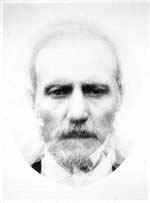
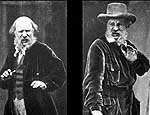
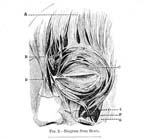
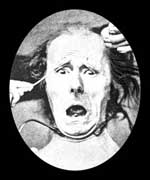
|
Darwin and
others like Cesare Lombroso turned to the cutting-edge technologies of the
day, electricity (which Lombroso applied to the clitorises of criminals in
order to measure the sensitivity to pain of these urban savages) and photography,
which Darwin, Lombroso and many others used to create composite photos,
such as in this portrait of melancholy made by superimposing the faces of
eight melancholic men.
But while non-catatonic expressions were fleeting, exposures
in 1890 were long. "I presume it will be hopeless, from constant movement,"
Darwin wrote, "to get an insane person photographed whilst crying bitterly."
To get around this technical problem, Darwin used photos of actors posed in various expressions.
He also sought to identify the exact muscles that were used in an expression of terror, for example.
If these muscles
of fright, as they were called, were then electrically contracted, and an
expression of terror was created, then a portrait of terror could be said
to have been objectively simulated. |
Narrative is always the "untainted" image's undoing.
Who was to judge what the expression created signified?
Galton had no qualms about the aesthetic judgments that inhered in his science;
to objectively determine through statistical measurement which city had
the most beautiful women, he stood on street corners and used marbles
in his pockets to mark each time he was passed by a woman who was "Beautiful,"
"Indifferent" or "Repugnant." Being a superior scientist
than Galton, however, Darwin was concerned with the blur between science
and aesthetics. "It occurred to me," wrote Darwin, "to show
several of the best plates, without a word of explanation, to above twenty
educated persons of various ages and both sexes, asking them in each case,
by what emotion or feeling the old man was supposed to be agitated."
Even considering what we can see as a survey of a very narrow sample, educated,
that is, white, upper-class Victorians, the judgments were divergent on
many of the images.
As a control group, Darwin observed the expressions of
animals: "In observing animals, we are not so likely to be biased by
our imagination; and we may feel safe that their expressions are not"
dictated by convention.
What is looked for is what is found, and Darwin, the evolutionist,
made sure that the observations of humans were consistent with these unbiased
animal expressions that he unemotionally observed.
Time has made Darwin's logic foreign enough for us to criticize
it from the detached viewpoint of an anthropologist among the strange rituals
of the Other. But the aesthetic aspect of knowledge that he demonstrates
in fashioning narratives from images reveals that we have more in common
with eminent Victorians than we are often aware, as the following rollover illustrates:

Using computerized imaging techniques, Dr. Silbersweig
and a team of researchers — note how easy it is to fall into the language
of our own time — a team of researchers were able to reduce to nano-seconds
the time it takes to click a shutter and picture regions of the brain that
are active during a hallucination.

Out goes the camera, in comes the computer; is mimesis
any more objective 100 years after Darwin? Are we, that is, to eliminate
the left side of the equivalency Ways of Seeing <-> Ways of Saying?
Well, let's look at the language of the narrative used to describe this
breakthrough, this picture of schizophrenia: "circuits of the brain"
and "the key switchboxes" and "neural circuits" and
"mistakes in the brain wiring". Which is to say, what we see when
looking through the computer is another computer.

Are you thinking in terms of vacuum tubes?
Should we dress our narrative in the Latinate verbiage
of the phrenologist? Or associate it with the objective connotations of
numbers and graphs?
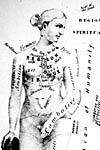
Buchanan's System of Anthropology |
 |
Should we show our graphs to a panel of 20 eminent Victorians?
Or cows? Old habits
die hard, and some old habits of thought don't seem to die at all.
As Dr. Silbersweig is quick to caution, "No one knows
the cause of [schizophrenia] or how to cure it." Or how to define
it, we might add; the same article points out, "genes play a part...but
the illness also seems to be triggered by life experiences."
So, is it mind or body? Or do you say, Nature or Culture,
Mr. Galton? Hearing voices was not always grounds for insanity. There was
not always a thing called insanity.
O Word! |
|
it certainly has a form, and
I The Chain:In Mervelous
of course, began as close
The rhetoric of medieval left unsaid by the symbol.
Christ was the Word
each being forming a
Dante to write his
Ah quanto a dir qual
spra e forte [C]
o è piu morte; [C]
ma per trattar del
example, a prayer for
is taught by a crucifixion
own life in order to be
of a fruit-bearing text
I can know a frog. And
purposes, which by the
can be seen as an
. This is the first Modern
differences by cause
example, as distinct
text from world, as
I increasing (imagine!)
consciousness. Kant is
for Foucault and others,
includes the gaze of the
articulations that assume
whether or not anyone
our present day.
being said either
at revealing God's
is hidden, that
The anthropologist's
pervasive achievement
method of literary
the great modern myth,
for example, where all
its form, not its content.
with a new plot-they
book much like the
of novel evolved-with
these tools of analysis-a
before Lacan by the
in fact be of nothing
re-presents riding
popular entertainment,
image/language effects,
our stories about and
-and becomes even more |

 seeing