|
The push of how we Which is to say, what Accordingly, each has I can use the rhetoric Still, in terms of a lite Likewise, the image/ |
After the revolution in the humanities, the re-writing of knowledge has become a given. Walk around any academic bookstore and note how many titles contain the word "archeology." 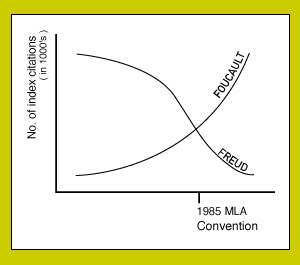
Indeed, walking through the stacks of a university library, it's easy to get the claustrophobic sensation that you're in a vast Victorian collection of beetles, the bulk of the specimens written in the days of catalog as Teleology. Like these books, like perspective painting, like a scientific theory or any narrative, the graphically-driven novel is a system for knowing that is inherently an argument about how the world is made up/perceived. But unlike traditional genres of the novel, the image/text in all its manifestations contains (like the word "narrative" itself) the collapse of genres: an understanding, sometimes explicit, sometimes not, that everything is written, including ourselves.
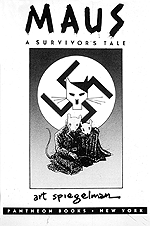
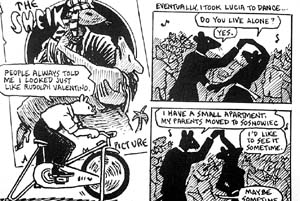
In Art Spiegelman's Maus, for instance, one panel depicts
Vladek telling the story of his courtship to the woman he married and who
died in the Holocaust and which he only escaped by narrowing the compass
of his concerns to survival. On the surface, the words themselves carry
the narrative forward. But once the graphics of the panel are considered,
it can be seen that they only do so in a horizontal, temporal way.
The picture of Vladek, now an old man bent over as he rides his exercise bike is superimposed on a movie poster of Valentino, harem girl swooning in his arms and the images (by collapsing narrative time, i.e., the linear plot) add a vertical dimension, a depth that in fact contains the real story: the fleeting nature of life, the transience of beauty, of youth, of vigor, the sheen of life that is so easy while in comfort to identify with life.... It speaks of the horror that always seems to be waiting below the surface by making a grotesquerie of the surface. Add to this the fact that Vladek, Valentino, and the girl are all drawn as anthropomorphic mice in a book where Nazis are depicted as cats and the drawings and words play off each other in yet a third way: they call into question received ideas of humanity; they illustrate and thereby make present the Darwinian subtext that informs the action of this novel about vermin to be exterminated and the predators who do it. Indeed, this fusion of animal imagery and non-fiction Holocaust narrative can be seen as a little opera on the page about the palimpsest each culture makes of its own habits of thought — acting out lines of thought that have been so thoroughly absorbed that they become a kind of nature — as a priori to reason as the alphabet is to writing. In Landscape and Memory, Simeon Schama reminds readers that to see the "ghostly outline of an old landscape beneath the superficial covering of the contemporary is to be made vividly aware of the endurance of core myths." His example is the contemporary appearances of the Virgin to a cleaning woman near Madrid. According to Schama, these visitations are written upon the legacy of the Most Catholic King of Spain, Philip II who built El Escorial, the monastery/tomb where they occur. El Escorial is itself a manifestation of "centuries of associations of apparitions of the Virgin seated in a tree whose Eastertide renewal of foliage symbolized the Resurrection" — a rewriting, of course, of "pagan myths that described old and hollowed trees as the tomb of gods slaughtered on the boughs and encased within the bark to await a new cycle of life." In Maus, Darwin, Galton, and Malthus seem to inform every panel of Vladek's life, a period where Darwinian logic flowered in a variety of eugenics programs throughout the world: at State Fairs in America, Fitter Family contests were staged in which whole families were judged like cattle (a layer of writing that survives as the Ms. America contest); based on the scientific IQ testing of immigrants at Ellis Island, H.H. Goddard found eastern Europeans to be feeble-minded. If these would-be immigrants were allowed into the country, they would "clog the wheels of progress," as Goddard put it. Basing its actions on voluminous amounts of research with the same conclusion, Congress passed the U.S. Immigration Restriction Act (which wasn't repealed until decades after its raison d' être had passed out of scientific fashion), keeping out almost all of the 220,000 German refugees who applied for visas to the US in 1938. Result: almost all of the visa applicants were gassed by 1943 — except, of course, those who were granted a non-quota visa because the special skills they possessed were needed in America. One of these was Dr. Gustav Aschafenburg, a genetic researcher whose own scientific narrative advocated the sterilization of the "vermin of the nation: the chronically ill, the criminal, the handicapped, the elderly, the alcoholics, the homeless and other 'incompletes,' i.e., burdens on society" — until he was forced to flee the Nazis. The fact that Dr. Aschafenburg was himself Jewish brings up the question, What does it mean to ask, 'How much did the average German know?' How much do we? Of course, there was nothing hidden about the assumptions behind Mein Kampf (My Struggle), a title which Hitler derived directly from the Darwinian phrase, "survival of the fittest." It was spelled out explicitly — "Whoever is not bodily and spiritually healthy and worthy shall not have the right to pass on his suffering in the body of his children" — even if the factor necessary to translate this proclamation into gas chambers was essentially an aesthetic judgment of "healthy" (a judgment call that, presumably, Dr. Aschafenburg did not agree with). Or perhaps another entry into this question is to ask how people who on the whole are well-intentioned can allow starvation to become as common as the McDonalds restaurants, diet colas, and laxatives hawked in between images of famine on network television. Hindsight is always 20/20. Especially when directed at another (and thus makes for good exemplary cases). The marriage of Darwinian assumptions and political will that set the story of Maus into action illustrate grimly how ways of speaking bring into existence ways of being, ways of acting, even unto writing into existence the institutionalization of murder, starvation and slavery. Even unto re-writing the self as an animal driven by little more than the instinct to survive. The frame of the book, i.e., Vladek telling his story to Spiegelman who is creating the story of Vladek telling his story to Spiegelman, underscores without saying that a History (or a people) that doesn't consider the way it is written, that takes documents, including itself at face value, is a naïve history (people). The same might be said of literature — a system of knowing. The inherent surface nature of the image/text, the insistence on its own methods and materials through surface, through corporeality, makes it seem particularly suited to our contemporary climate of contentious reading. The rise of the image, including the image text, as texts have always done, helps make us what we are through the practice of their creation and consumption. In an image-driven culture, they allow a text to casually draw attention to patterns of thought that have been so well traveled they have achieved the status of Nature. Or else further contribute to their naturalization.
|
denotation can be cleaved from tragedy in limerick?). If for lack high-mindedness replaces rules associative world of court this. Ask, 'What are the politics of could slog out a rhetorical than our parents could live in a Freud. Whether or not we have lit-crit names. Today, the thereby undermining the practices have trickled down Othello, a structuralist in search wind instruments? Musician: Ay, marry, are they, hangs a tale, sir. that I know.
like to say, moves by opening has become as common as vernacular. Us. We The People. Shakespeare quote and then Prosecution (a structuralist): Light leather gloves exist. Fact gloves was found at the murder the defendant and one out of 57 by a killer wearing rare Bruno ugly ass shoe like that! racists bring in photos of a man lab results, words and other think he is guilty and want to Prosecutor: Hey, "framing the O! Word! |
 seeing
saying
knowing
writing
writing
being
seeing
saying
knowing
writing
writing
being